





Companies adopting HR automation are cutting HR workload by up to 40%, reducing payroll processing time by as much as 80%. This frees teams to focus on hiring, employee engagement, and strategic growth.
That is exactly why investing in the right HRMS software for companies in Dubai rely on has become a business priority in 2026.
Dubai’s workforce is becoming more diverse, more digital, and more demanding. For growing companies with 50 to 500 employees, HR operations become a hassle. Whether operating in DIFC, JLT, DAFZA, or mainland Dubai, administrative tasks directly impact compliance, productivity, employee satisfaction, and your ability to scale.
But this should concern you:
Not every HRMS platform is built for Dubai’s business environment. Some offer powerful global features but require extensive customisztion for UAE payroll and compliance. Others are designed with local requirements in mind, helping HR teams launch faster and operate more efficiently. Wondering which one to pick?
This article has got you covered. Discover the top HRMS software in Dubai, compare features, and understand pricing expectations. Identify which solution best fits your organisation’s size, industry, and long-term HR strategy.
What Is The Best HRMS Software In Dubai?
For SMEs and growing companies in Dubai, Connect HR is one of the strongest options because it combines UAE payroll, WPS compliance, attendance management, employee self-service, and local support in a single platform.
What Dubai Businesses Need from HRMS Software
Dubai companies face unique HR requirements. They must manage a diverse workforce, maintain accurate records, process salaries correctly, and stay aligned with UAE employment regulations.
When evaluating HRMS software Dubai providers, decision-makers should look beyond basic employee databases and focus on platforms that improve operational efficiency.
What We Commonly See Across UAE HR Teams
Based on common challenges reported by HR departments across UAE SMEs and mid-sized businesses, the most frequent operational issues include:
- Manual payroll processing
- WPS file errors
- Attendance discrepancies
- Leave approval bottlenecks
- Fragmented employee records
- Compliance documentation gaps
HRMS platforms help centralize these functions while reducing administrative workload and improving operational consistency.
UAE Payroll and WPS Compliance
Payroll errors affect employee trust and create unnecessary administrative work. A reliable HRMS should automate salary calculations, manage allowances and deductions, and generate WPS files accurately.
For companies looking for dependable payroll software Dubai providers, UAE-specific payroll functionality should be a non-negotiable requirement rather than an additional feature.
Leave, Attendance, and Shift Management
Companies with larger teams need a system that manages annual leave, sick leave, public holidays, attendance records, and shift schedules without manual tracking.
A modern HR system Dubai businesses invest in should provide real-time attendance insights and automated approval workflows.
Employee Self-Service Experience
HR teams should not spend hours handling routine employee requests. Employee self-service portals allow staff members to apply for leave, access payslips, update personal information, and view company documents independently.
This reduces HR workload and improves the overall employee experience.
UAE Labour Law and Free Zone Requirements
Businesses operating in locations such as DIFC, JLT, and DAFZA require a system that maintains proper employee records and supports UAE-specific HR processes.
A robust HRMS UAE solution helps companies maintain organized documentation and reduces the risk of compliance gaps.
Scalability and Multi-Location Management
Growing companies require software that adapts as their workforce expands. The ideal solution should support additional employees, departments, locations, and advanced HR workflows without requiring a migration to another platform.
Understanding HRMS Software Categories
Different HRMS platforms are designed for different business needs.
- Connect HR → UAE Payroll & WPS Compliance
- Bayzat → Benefits Administration
- Zoho People → HR Workflow Automation
- SAP SuccessFactors → Enterprise Workforce Management
- Darwinbox → Employee Experience & Automation
Understanding these differences helps businesses choose software aligned with their operational priorities.
Top 5 HRMS Platforms Reviewed for Dubai (2026)
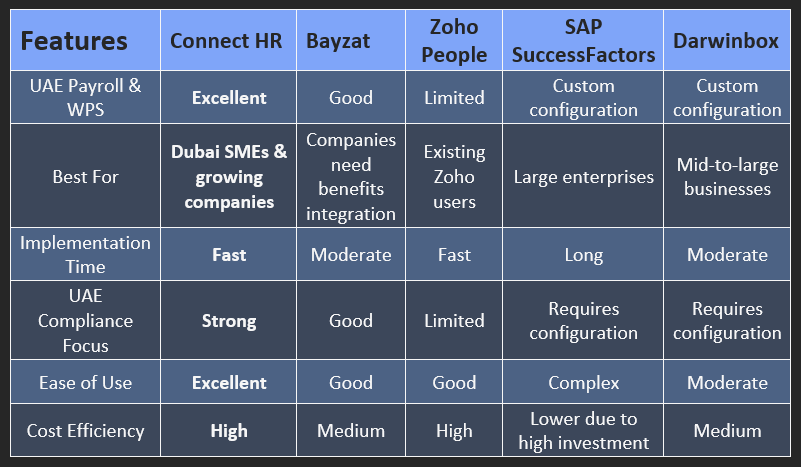
Choosing the right HRMS is easier when you compare platforms based on UAE compliance, payroll capabilities, ease of implementation, scalability, and overall value for your business.
1. Connect HR — Best for UAE Compliance and No-Fuss HR
Connect HR is designed specifically for UAE businesses and is a strong choice for companies that prioritize local compliance, ease of implementation, and practical HR automation.
Unlike global platforms that often require extensive customization for UAE processes, Connect HR delivers features that directly address the needs of Dubai-based businesses.
Key advantages include:
- UAE WPS-ready payroll management
- Leave and attendance automation
- Employee self-service portal
- Digital employee document solutions in Dubai-focused HR workflows
- Fast implementation with minimal employee training
- Local customer support
For SMEs and growing organizations, Connect HR provides one of the most practical HRMS software Dubai solutions by balancing compliance, usability, and cost efficiency.
2. Bayzat – Benefits Ecosystem
Bayzat is a well-known name among HR software companies in Dubai due to its combination of HR management, payroll, insurance, and employee benefits.
Its major features include the following:
- Payroll processing
- Benefits administration
- Employee mobile application
- Leave and attendance tracking
- HR workflow management
It works well for businesses seeking a broader employee benefits ecosystem alongside core HR functions.
3. Zoho People – Flexible Setup
Zoho People is a cloud-based HR platform suitable for companies that already use other Zoho applications.
Key capabilities include:
- Employee database management
- Workflow automation
- Attendance tracking
- Leave management
- Performance reviews
It is suitable for smaller and mid-sized businesses, though organizations should assess whether additional tools are needed for advanced UAE payroll requirements.
4. SAP SuccessFactors – Global Control
SAP SuccessFactors is an enterprise-grade HR platform designed for large organizations with complex workforce management needs.
Its features include:
- Global HR administration
- Talent acquisition
- Performance management
- Learning and development
- Advanced workforce analytics
Large companies with international operations may benefit from its extensive functionality, although implementation costs and timelines are generally higher.
5. Darwinbox – Experience First
Darwinbox provides a modern, cloud-based HR experience with strong automation capabilities.
Its key features include:
- Core HR management
- Recruitment tools
- Attendance and leave management
- Employee engagement features
- Performance management
It is a suitable option for mid-sized and enterprise businesses looking for a comprehensive HR ecosystem.
A Quick Look into Features!
Dubai-Specific Compliance Checklist
Use this checklist to compare solutions before selecting an HRMS software Dubai vendor,:
✓ WPS-ready payroll processing
✓ UAE salary structure management
✓ Leave and attendance automation
✓ Employee document storage
✓ Approval workflows
✓ Secure cloud-based data management
✓ Employee self-service portal
✓ HR reports and audit records
A platform designed for UAE operations reduces manual HR work and supports better compliance management.
Businesses should also review requirements issued by:
- UAE Ministry of Human Resources and Emiratisation (MOHRE)
- Wage Protection System (WPS)
- DIFC Employment Law
- Relevant Free Zone regulations
Pricing Guide: What Dubai Companies Pay
Remember these factors: company size, required modules, implementation complexity, and support services. The cost of HRMS software Dubai solutions depends on them.
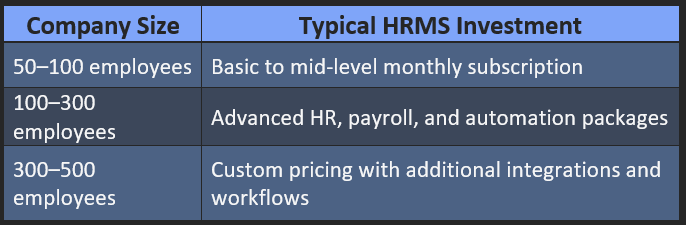
While comparing costs, businesses should consider implementation speed, local support, compliance features, and long-term value rather than selecting the lowest-priced option.
Best HRMS Software By Industry
Construction Companies
Need workforce attendance tracking, payroll automation, and site-based employee management.
Healthcare Organizations
Require shift scheduling, compliance management, and workforce planning. Explore how healthcare organizations can benefit from HRMS software for hospitals in UAE.
Hospitality Businesses
Need leave tracking, attendance management, and employee self-service tools. Here is complete guide on HRMS software for Hospitality businesses in UAE.
Retail Businesses
Benefit from scheduling automation, payroll management, and workforce visibility.
How to Select the Right HRMS for Your Dubai Business
Choosing the right HR system in Dubai becomes easier when you follow a clear, structured approach. Each step below helps HR Directors and Operations Managers narrow down options based on real business needs, UAE compliance, and long-term scalability.
Step 1: Check if it actually handles UAE payroll and WPS
Start here, always. If the system doesn’t fully support WPS payroll, salary calculations, and UAE deductions, everything else becomes secondary.
A good system should quietly handle compliance in the background while your team focuses on actual work, because manual payroll mistakes can cost companies hours every month and even lead to compliance penalties.
Step 2: See how easy it feels for your HR team and employees
If it feels complicated, it won’t work in real life. Simple as that.
Look for dashboards that make sense instantly, mobile access for employees, and self-service options that reduce HR workload by almost 30% in many mid-sized companies.
Step 3: Understand how fast it can be implemented
Time matters more than features sometimes. A system that takes 3 months to implement often slows down HR transformation.
You want something that gets your team running in weeks, not quarters, especially when your business is scaling, and every delay affects internal operations.
Step 4: Make sure it can grow with your business
Today, you may have 80 employees, but what happens when you hit 300?
Choose a platform that doesn’t break when you scale, because switching HR systems later disrupts everything from payroll to employee records.
Step 5: Look closely at UAE compliance and local support
This is where many global tools fall short. UAE labour rules, free zone policies, and WPS requirements need local understanding.
A strong system reduces compliance risks by up to 50% when properly aligned with UAE regulations, which is why local expertise matters more than fancy features.
Step 6: Compare cost with actual value, not just price tags
Cheap software often becomes expensive later. It sounds dramatic, but HR teams feel this every month when manual work piles up.
Instead of focusing only on subscription cost, check how much time and manpower the system saves your team across payroll, attendance, and reporting.
Step 7: Test reporting before you commit
Reports are where HR leaders make decisions. If reporting is weak, decision-making slows down immediately.
Look for real-time dashboards, payroll summaries, and workforce insights that help you see patterns clearly instead of guessing what’s happening inside your organization.
Key Takeaways
- Connect HR is strongest for UAE-focused payroll and compliance.
- Bayzat is suitable for benefits-focused organizations.
- Zoho People works well for existing Zoho users.
- Darwinbox offers a modern employee experience platform.
- SAP SuccessFactors is designed for large enterprises.
The right choice depends on workforce size, compliance requirements, implementation timeline, and long-term growth plans.
Frequently Asked Questions
What is the best HRMS in Dubai for mid-sized companies?
The best HRMS Dubai businesses to choose from depend on their priorities. Companies requiring UAE payroll, WPS compliance, and quick deployment often prefer locally focused solutions like Connect HR. On the other hand, enterprises may select global platforms with advanced workforce management tools.
Which HRMS software supports UAE payroll and WPS?
Several HRMS solutions provide UAE payroll capabilities, but the level of automation differs. Businesses should confirm that the software manages salary structures, deductions, allowances, and WPS file generation.
How much does HRMS software cost in Dubai?
HRMS pricing varies based on employee count, required features, and implementation needs. Mid-sized companies usually invest in solutions that provide payroll, attendance, self-service, and compliance features in one platform.
How long does HRMS implementation take?
Implementation timelines depend on company size and software complexity. Locally focused solutions usually have faster deployment times, while enterprise platforms may require weeks or months of configuration and customization.
Is cloud HRMS secure for Dubai businesses?
Yes. Modern cloud-based HRMS platforms use security measures such as data encryption, access controls, backups, and permission-based user management to protect employee information.


