
Overtime Calculation in UAE: A Complete Guide for Employers (2025)
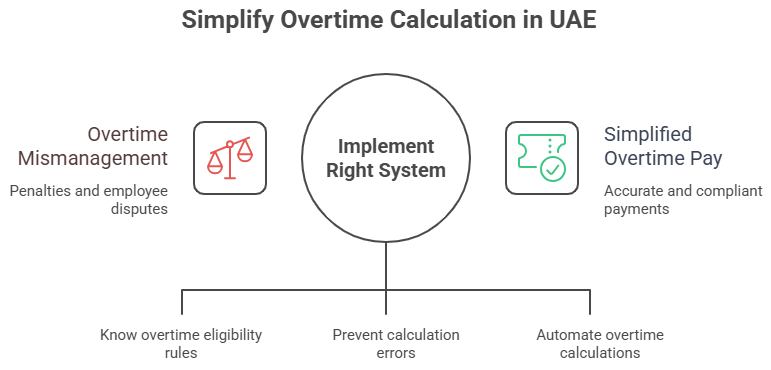
Managing overtime pay becomes stressful for UAE employers. According to a recent UAE Labour Market report, nearly 4 out of 10 small to mid-sized businesses have faced penalties. They are constantly under pressure to avoid employee disputes due to overtime mismanagement. From checking the eligibility to calculating the right pay, overtime calculation in UAE can become a nightmare if it goes wrong.
However, the good news is that it can be straightforward with the right tool and strategy. This guide is your starting point to understand what the law says, where most companies go wrong, and how you can simplify it all with the right system in place.
Understanding Overtime Laws in the UAE:
Understanding the rules around UAE overtime laws is crucial for every employer. Many businesses unintentionally violate these regulations because they don’t fully grasp the details or assume they don’t apply to them. Staying updated with the 2025 labor law changes helps protect your company from fines, keeps your staff happy, and promotes fair workplace practices. Whether you’re hiring new staff or scaling operations, knowing what the law says about overtime is a must.
What Is Overtime According to UAE Labour Law?
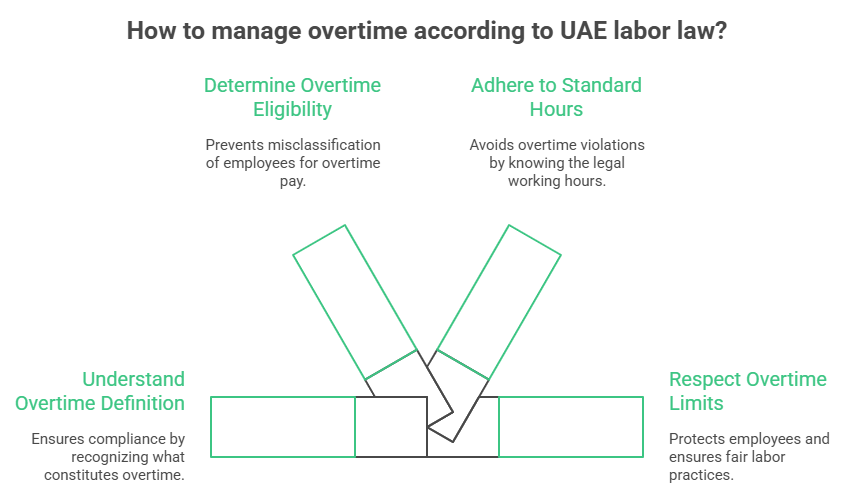
Overtime isn’t just extra hours—it’s a legal obligation that must be handled properly. According to the UAE Labour Law overtime guidelines, any work done beyond the standard working hours must be paid for at an increased rate. In simple terms, if an employee stays late or comes in early outside of agreed-upon hours, that counts as overtime. Employers must ensure they’re not violating labor rules by treating those hours as regular work time.
Who Is Eligible for Overtime Pay?
Not every employee qualifies for overtime; this is where many employers make mistakes.
Eligible employees typically include junior staff, workers in physical roles, or support staff who follow fixed schedules. Exempt employees usually hold managerial or decision-making roles and may not qualify for overtime due to flexible hours.
To avoid misunderstandings, it’s important to clarify overtime eligibility in contracts and consult MOHRE’s guidelines when in doubt.
- Eligible: Non-managerial employees, support staff, laborers, and clerical workers.
- Not eligible: Employees in managerial, supervisory, or policy-making positions, especially those whose roles allow flexible hours or are performance-based.
Contracts should clearly state whether the employee qualifies for overtime pay, and this classification must be in line with MOHRE guidelines.
Standard Working Hours in the UAE:
Before calculating overtime, you need to understand what counts as ‘standard hours.’
The UAE Labour Law states that private-sector employees can work a maximum of 8 hours per day or 48 hours per week. For government employees, it’s typically 7 hours a day. During Ramadan, the workday shortens to 6 hours for Muslim employees.
Anytime worked beyond these limits (unless pre-approved) may count as overtime and must be compensated accordingly.
- Private Sector: Maximum of 8 hours per day or 48 hours per week.
- Government Sector: Typically 7 hours per day.
- During Ramadan, 6 hours per day for all Muslim employees, regardless of sector.
Employers must seek prior approval from the Ministry of Human Resources and Emiratisation (MOHRE) for any variations.
Legal Overtime Limits and Exceptions:
You can’t just assign overtime endlessly. The UAE imposes limits to protect employee well-being and ensure fair labor practices.
By law, overtime shouldn’t exceed 2 hours per day unless there’s an urgent reason, like preventing equipment failure or loss. Nighttime work (10 PM to 4 AM) is treated with special attention and requires a higher pay rate. Public holidays and weekends are sensitive too—employees must either receive 1.5x pay or a day off in lieu.
Certain industries, such as healthcare and aviation, may have different exceptions, but even then, MOHRE approval is essential.
- Maximum 2 hours per day unless work is critical (e.g., preventing loss or damage).
- Nighttime work (10 PM to 4 AM) must be compensated at a higher rate unless it’s part of a scheduled shift.
- Weekends and public holidays: Employees must receive a compensatory off day or 150% pay.
Exceptions apply to certain industries like aviation, hospitality, and emergency services, but written approvals and documentation are essential.
How to Calculate Overtime in the UAE?
Many businesses struggle with how to calculate overtime in the UAE, especially when different scenarios like night shifts, weekend work, or holiday schedules are involved.
Getting the calculation wrong can not only cost you money but also affect employee trust. That’s why it’s important to understand the correct formulas and apply them consistently. This section walks you through the key types of overtime, with clear examples to guide you.
Employers must calculate overtime using the employee’s basic monthly salary, excluding allowances, commissions, and bonuses.
Daytime Overtime Calculation:
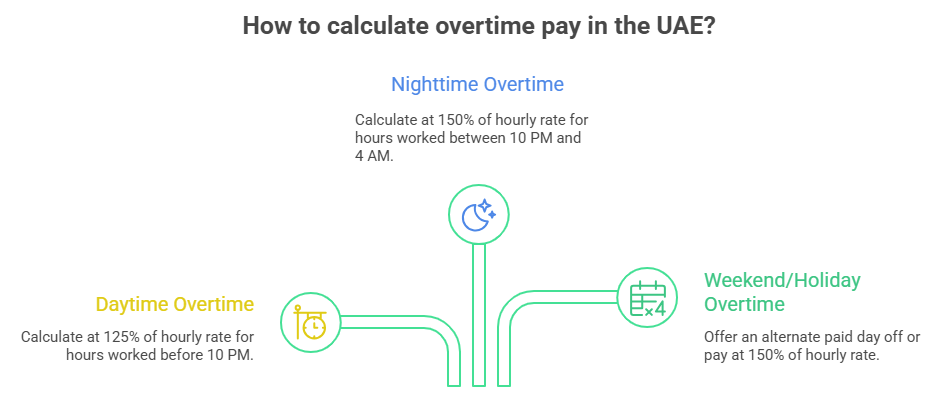
Overtime during regular daytime hours (outside of contracted hours but before 10 PM) is compensated at 125% of the hourly wage.
Formula:
Hourly Rate = Basic Monthly Salary ÷ 30 ÷ 8
Overtime Pay = Hourly Rate x 1.25 x Overtime Hours
Example: If basic salary = AED 6,000:
Hourly Rate = 6,000 ÷ 30 ÷ 8 = AED 25
2 hours overtime = 25 x 1.25 x 2 = AED 62.50
Nighttime Overtime Calculation:
Overtime between 10 PM and 4 AM is paid at 150% of the hourly rate, unless the employee is a night-shift worker.
Formula:
Overtime Pay = Hourly Rate x 1.5 x Overtime Hours
Example: Using AED 25 hourly rate:
3 hours night overtime = 25 x 1.5 x 3 = AED 112.50
Weekend and Public Holiday Overtime:
If employees work on official holidays or weekends, they must receive:
- An alternate paid day off, or
- Pay at 1.5 times the regular hourly rate
Formula:
Overtime Pay = Hourly Rate x 1.5 x Holiday Hours Worked.
Example Calculations for Common Scenarios:
Assume a basic monthly salary of AED 4,000:
Hourly Rate: AED 4,000 ÷ 30 ÷ 8 = AED 16.67
| Scenario | Hours | Rate Multiplier | Total Pay (AED) |
| Weekday Overtime | 2 | 1.25 | 41.68 |
| Night Overtime | 3 | 1.5 | 75.02 |
| Public Holiday (Full Day) | 8 | 1.5 | 200.04 |
Overtime calculation in UAE is more than just math—it requires precision and up-to-date knowledge of the law.
Common Mistakes Employers Make in Overtime Calculations:
Even experienced HR teams can make mistakes when it comes to overtime calculation in UAE. These errors often go unnoticed until they result in staff complaints or official penalties. Understanding where employers typically go wrong—like tracking errors, wrong classifications, or using the wrong pay base—can help you fix the process before it becomes a legal issue. Let’s look at where businesses tend to slip up.
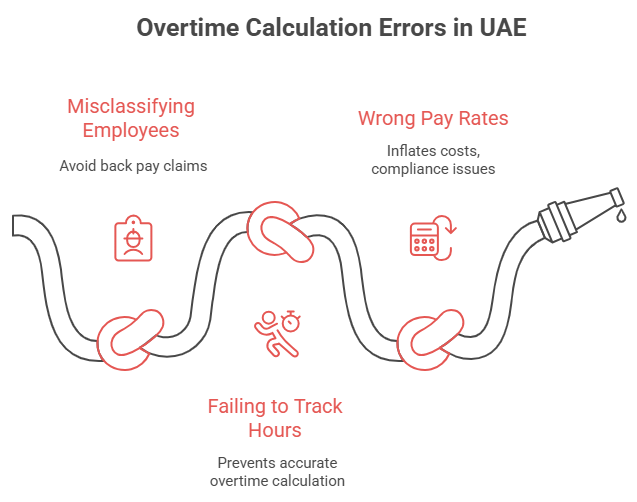
Misclassifying Employees:
One of the biggest legal traps is misclassifying employees. Just because someone has a managerial title doesn’t mean they’re exempt from overtime.
The law looks at job responsibilities, not titles. For example, a ‘supervisor’ who follows a fixed shift and doesn’t make key decisions may still qualify for overtime. Misclassification can lead to back pay claims and legal penalties.
Regular reviews of roles and responsibilities help avoid this issue.
Failing to Track Exact Hours:
Guesswork has no place in overtime management. If you rely on manual inputs or inconsistent tracking systems, you’re setting yourself up for disputes.
You must record the exact number of hours each employee works every day. This includes logging breaks and time spent outside regular duties. Without this data, you’re likely to overpay, underpay, or miss violations entirely.
Digital solutions like ConnectHR can automate and standardize this process to reduce risk.
Not Accounting for Different Pay Rates:
Another common mistake is calculating overtime based on gross salary. This is not allowed under UAE labour law overtime rules.
Overtime must be based strictly on the basic salary, excluding housing, travel, or other allowances. Failing to do this inflates costs and could lead to compliance issues if challenged during an audit.
Make sure your payroll system distinguishes between total compensation and basic pay to calculate overtime correctly.
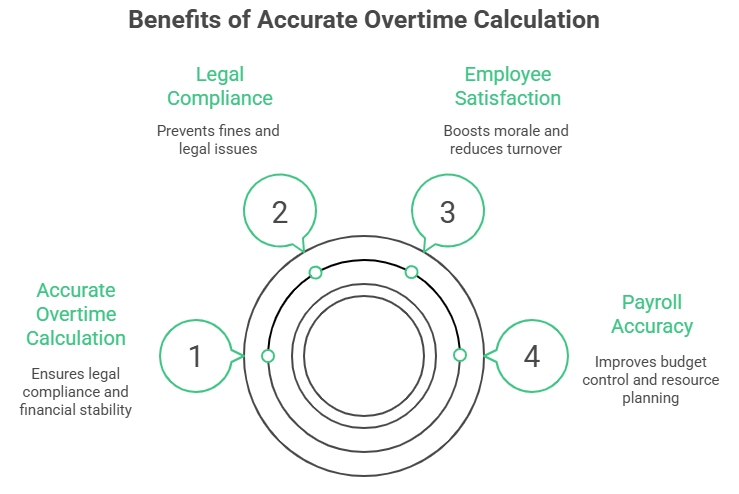
Why Accurate Overtime Calculation Matters for Your Business?
When you get the overtime calculation in UAE right, it pays off in more ways than one. Not only do you avoid legal penalties, but you also build employee trust and maintain a positive work environment. From cleaner audits to smoother payroll processes and better staff retention, the benefits are clear. Here’s why this area of HR deserves more attention than it usually gets.
Legal Compliance and Penalties:
Errors in overtime payment can result in:
- Heavy administrative fines.
- Court disputes.
- Labor bans or trade license suspension.
Staying compliant with UAE overtime laws protects your business and reputation.
Employee Satisfaction and Retention:
Correct and timely compensation boosts employee morale. Fair practices contribute to lower attrition, higher productivity, and better company culture.
Payroll Accuracy and Budget Control:
Accurate calculations help businesses:
- Avoid unnecessary expenses.
- Plan resources better.
- Make informed decisions about staffing and scheduling.
How ConnectHR Simplifies Overtime Calculation in UAE?
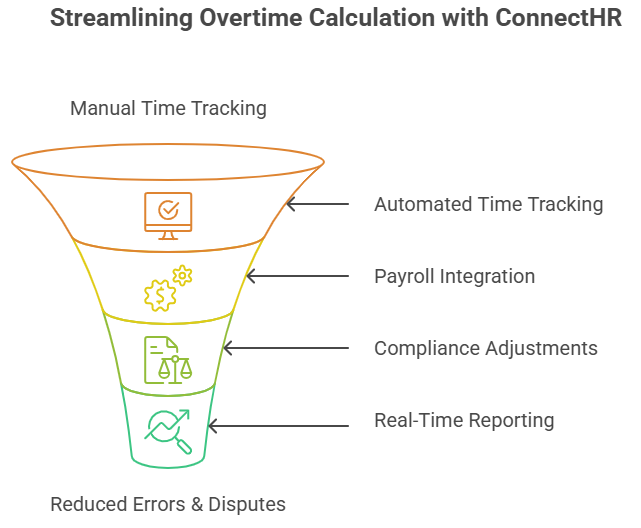
For businesses struggling with time tracking and payroll, ConnectHR is a game-changer that streamlines overtime calculation in UAE by taking the guesswork out of every step. From automating inputs to generating legally compliant reports, ConnectHR frees up your HR team to focus on strategic tasks—no spreadsheets and disputes. Here’s how it works in real-world business settings.
1, Automated Time Tracking and Payroll Integration: ConnectHR records employee time automatically, ensuring no missed hours. Its payroll module syncs overtime data seamlessly for accurate payouts.
2, Compliance with UAE Labour Laws Built In: Built with UAE Labour Law overtime logic, ConnectHR automatically adjusts calculations during Ramadan, public holidays, and night hours, minimizing human error.
3, Real-Time Reports and Audit Trails: Track overtime by employee, department, or date range. Export detailed reports with audit history for internal HR reviews or MOHRE audits.
Case Study: UAE Business Saved Time & Errors with ConnectHR
Before using ConnectHR, Movey a logistics company struggled with payroll errors and constant employee complaints about overtime. After adopting the system, they saw a 90% drop in disputes and saved over 40 hours of admin work each month while remaining fully compliant during audits.
Final Thoughts: Take the Hassle Out of Overtime Management.
If tracking overtime feels like a burden, you’re not alone. Most growing businesses in the UAE feel the same. With smart tools like ConnectHR, overtime calculation in UAE becomes one less thing to worry about. You get peace of mind, and your employees get paid fairly—every time.
Why UAE Businesses Are Switching to ConnectHR?
From SMEs to large enterprises, businesses across the UAE are choosing ConnectHR to automate HR workflows, reduce compliance risks, and ensure payroll precision.
- Reduce manual tasks
- Maintain legal compliance
- Build employee trust with fair pay
Don’t let outdated systems put your business at risk. Book your free ConnectHR demo today and see how effortlessly it manages overtime, payroll, and UAE labour law overtime compliance.
ConnectHR helps you pay right, stay legal, and grow faster.
Ready to simplify your work with Connect HR?
Book a demoGet started with ConnectHR
Would you like to have your free trial with Connect HR?
Looking for more insights?
Select a category below to explore additional content from the ConnectHR blog
